
Map of El Born: where everything is, and how long each walk takes
El Born is a small quarter that takes a while to cross, because every lane turns. The ten points below are the ones people actually walk to, and the distances between them on this page were measured on the OpenStreetMap foot network on 22 November 2026 — on two independent routing engines wherever a range is printed, and on one where the row says so. The minutes are a measurement with an error bar, not an estimate. The three metro doors our how to get to El Born page treats as the quarter's entrances are all in the first table, each timed to both ends of the quarter.
The short answer. Jaume I to the middle of Passeig del Born: 454–539 m, 6.1–6.5 minutes. Barceloneta to the Born Market: 554–558 m, 7.0–7.4 minutes. Urquinaona to the Passeig: 1,085–1,338 m, 14.5–16.1 minutes. The furthest of the six walks between the quarter's own four points is 317 m, which is about four minutes.
Ten points, one map
Pin 1 is the station most people arrive at. Pin 2 is the one to use when your bed is nearer the port than the church, and pin 3 comes in from the Eixample. Pins 5 to 8 are the four things you came for — the basilica, the avenue, the market and the Picasso — and they sit inside a triangle you can cross in four minutes. Pins 4 and 9 are how the water side reaches the quarter, and pin 10 is the northern metro door, a kilometre out.
Click or tap a numbered pin for its name. Map tiles © OpenStreetMap contributors.
The same map on paper
Nothing on this page needs JavaScript to be useful. The plan below plots the same ten points from their coordinates, to scale, with a 200-metre bar so you can read the distances off it. It is a plot rather than a street map — we have drawn the positions we measured, not lanes we did not survey — and it prints.
What is at each of the ten points
- Jaume I (L4) — on Via Laietana, the closest metro to the quarter, and step-free: the lifts at Plaça de l'Àngel and at Argenteria are the two ways in.
- Barceloneta (L4) — on Plaça de Pau Vila, one stop from Jaume I on the yellow line. The station to use when your hotel is nearer the port than the church.
- Urquinaona (L1/L4) — the Via Laietana side of the station, which is the side you walk from. It is the door from the Eixample and from line 1.
- Estació de França — Rodalies regional trains, on Avinguda del Marquès de l'Argentera, a few minutes' walk from the market. The building itself is worth the detour.
- Santa Maria del Mar — the basilica at the seaward end of the quarter, 154–155 m from the middle of the Passeig.
- Passeig del Born — the pedestrian avenue that the quarter is built around, and the point most distances on this page are measured to.
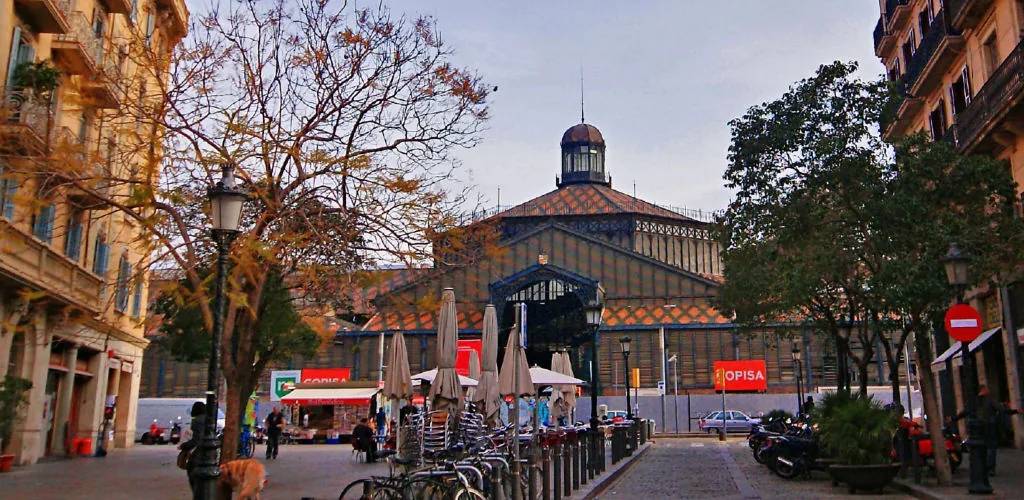
- Born Market / El Born CCM — the 1876 iron-and-glass market hall on Plaça Comercial 12, with the city that stood there before 1714 preserved underneath it.
- Picasso Museum — in the medieval palaces along Carrer de Montcada, 209–210 m from the Passeig.
- Pla de Palau — the square at the bottom of the quarter, where the old port begins.
- Arc de Triomf (L1) — a kilometre north on Avinguda de Vilanova. A secondary door: it works for a hotel near the Parc de la Ciutadella, not for a first arrival.
How long each walk takes
Two pedestrian routers, OSRM and Valhalla, were asked the same journey on the same day, and every walk we hold on both prints the range between their answers rather than one number. Two of the table rows below — Estació de França to the market, and Arc de Triomf to the Passeig — are measured on one engine only; each says so in its own cell and prints a single figure instead. The two engines assume different paces — 4.5 km/h and 5.0 km/h — and the spread is the honest error bar rather than a disagreement to be averaged away. Metres are the path you actually walk along the lanes, not the straight line between two dots.
The three metro doors
| From | To | Metres | Minutes | What the reader does |
|---|---|---|---|---|
| Jaume I (L4) | Middle of Passeig del Born | 454–539 m | 6.1–6.5 | Exits onto Via Laietana, south-east through Carrer de Jaume I and Argenteria into the avenue |
| Barceloneta (L4) | Born Market / El Born CCM, Plaça Comercial 12 | 554–558 m | 7.0–7.4 | North from Plaça de Pau Vila past Pla de Palau, up Carrer de la Ribera and Bonaire to Plaça Comercial |
| Urquinaona (L1/L4) | Middle of Passeig del Born | 1,085–1,338 m | 14.5–16.1 | South down Via Laietana, then into the lanes at the top of the quarter |
| Jaume I (L4) | Born Market | 554–620 m | 7.3–7.4 | The same route, carried on past the avenue to Plaça Comercial |
| Barceloneta (L4) | Middle of Passeig del Born | 472–476 m | 6.0–6.3 | As above, but turning into the avenue at its south end rather than at the market |
| Urquinaona (L1/L4) | Born Market | 1,121–1,391 m | 15.0–16.7 | Via Laietana, then the lanes up to Plaça Comercial |
| Barceloneta (L4) | South end of Passeig del Born | 378–385 m | 4.8–5.1 | The shortest way into the quarter from the port side |
| Jaume I (L4) | Santa Maria del Mar | 299–385 m | 4.0–4.6 | Two engines that part at the basilica: OSRM stops at the west front (299 m), Valhalla runs on through the lanes to 385 m |
The rail station, and the northern door
| From | To | Metres | Minutes | What the reader does |
|---|---|---|---|---|
| Estació de França | Middle of Passeig del Born | 273–289 m | 3.5–3.6 | Out onto Avinguda del Marquès de l'Argentera and along to the avenue |
| Estació de França | Born Market | 210 m | 2.8 | One router only (OSRM): the shortest measured walk to the market building from any station on this page |
| Arc de Triomf (L1) | Middle of Passeig del Born | 977 m | 13.0 | One router only (OSRM): north-west along Avinguda de Vilanova and down through the lanes. A secondary door; we have not confirmed which of the station's two entrances a reader uses |
Inside the quarter
| Between | Metres | Minutes | Which way |
|---|---|---|---|
| Middle of the Passeig — Born Market | 107–112 m | 1.2–1.5 | North-east |
| Middle of the Passeig — Santa Maria del Mar | 154–155 m | 1.8–2.1 | South-west |
| Middle of the Passeig — Picasso Museum | 209–210 m | 2.5–2.8 | West-north-west |
| Born Market — Picasso Museum | 307–317 m | 3.9–4.1 | West-south-west |
| Santa Maria del Mar — Picasso Museum | 175 m | 2.1–2.3 | North-north-west |
| Santa Maria del Mar — Born Market | 261 m | 3.0–3.5 | North-east |
"Which way" is the compass bearing between the two pins on the plan above — straight, not the turn of the lanes.
Route A: if you only have two hours
Arrive at Jaume I, end at the Picasso. Four stops, in this order, and every leg is a row in the tables above:
- Jaume I → Santa Maria del Mar — 299–385 m, 4.0–4.6 minutes (two engines: OSRM 299 m at 4.0 minutes, Valhalla 385 m at 4.6).
- Santa Maria del Mar → middle of Passeig del Born — 154–155 m, 1.8–2.1 minutes.
- Passeig del Born → Born Market — 107–112 m, 1.2–1.5 minutes.
- Born Market → Picasso Museum — 307–317 m, 3.9–4.1 minutes.
Add the legs and you get 873–963 m of walking and 11.6 minutes of it moving: 872.9 m in 698.2 seconds if you take the OSRM side of every row, 963.0 m in 696.5 seconds if you take the Valhalla side. The metres spread and the clock does not, because Valhalla's 90 m of extra lane is walked at 4.98 km/h against OSRM's 4.50, which leaves the two totals 1.7 seconds apart. Everything else in the two hours is standing still, which is the point of the route: the four stops are within 317 m of one another, so the walking is never what fills the time. Start with the basilica and end with the Picasso: the museum sets its own pace, and you will not want to hurry it.
Route B: from the sea
Barceloneta station to the south end of the Passeig is 378–385 m, 4.8–5.1 minutes: the shortest way into the quarter from the port side. Then walk the avenue north — it is pedestrian and flat — and the market door is a further 107–112 m, 1.2–1.5 minutes from the middle of the avenue. The two measured legs come to 485–497 m and 6.1–6.6 minutes of moving (364–398 seconds, each engine's own times added across both legs — OSRM 308.1 + 89.4 s, Valhalla 289.0 + 74.6 s), which leaves the rest of the morning for the building itself.
The archaeology under the market roof is the reason to end here rather than at the basilica. The Mercat del Born page carries what is inside the hall, what the building and its exhibitions cost, and the one weekday it closes — the details this page deliberately does not repeat, because they change and the market page is the one we keep current.
What these numbers are, and what they are not
They are a graph, not a stopwatch. Both routers follow the OpenStreetMap foot network, which knows the lanes, the steps and the pedestrian streets, but neither models a crowd, the Passeig's market stalls or anyone stopping to look at a doorway. A Sunday afternoon takes longer than any row here says.
Three caveats belong with the figures rather than in a footnote:
- Jaume I has three exits. The station figures are measured from the node on the Via Laietana frontage, 454 m to the middle of the avenue. From the Plaça de l'Àngel lift exit the same engine routes 505.5 m to the same point — about 50 m more — and times it at 6.7 minutes rather than 6.1–6.5. The table does not change; your exit does.
- Urquinaona is measured from its Via Laietana node, the El Born side. The Ronda de Sant Pere side adds about 90 m to every figure.
- Arc de Triomf is the row to treat with care: the station has a metro entrance and a Rodalies entrance about 150 m apart, and our one figure — 977 m, 13.0 minutes — is from the Avinguda de Vilanova node, measured on one router only (OSRM). It has no second-engine check, which is why that row prints a single number rather than a range.
What the numbers cannot tell you is step-free access: neither router models it, and the quarter's lanes include steps without a ramp. Our transport page carries the step-free statement for Jaume I, which is the station it matters for.
Where to go next
Five pages take this further:
- How to get to El Born — the airport, the metro and each of the three doors in detail.
- Things to see in El Born — Santa Maria del Mar, the Palau de la Música and the market of Santa Caterina.
- Things to do in El Born — the stops in walking order, with the museums' hours and entry fees.
- 48 hours in El Born — what to do when the two hours become two days.
- Passeig del Born — the avenue the map keeps returning to: its history, its number 18 and its cafés.