
History

The Born was once called the Ribera del Rec Comtal, after the channel that ran through it, and also the Vilanova — Vilanova de Mar in its longer form, one name with two versions rather than two places.
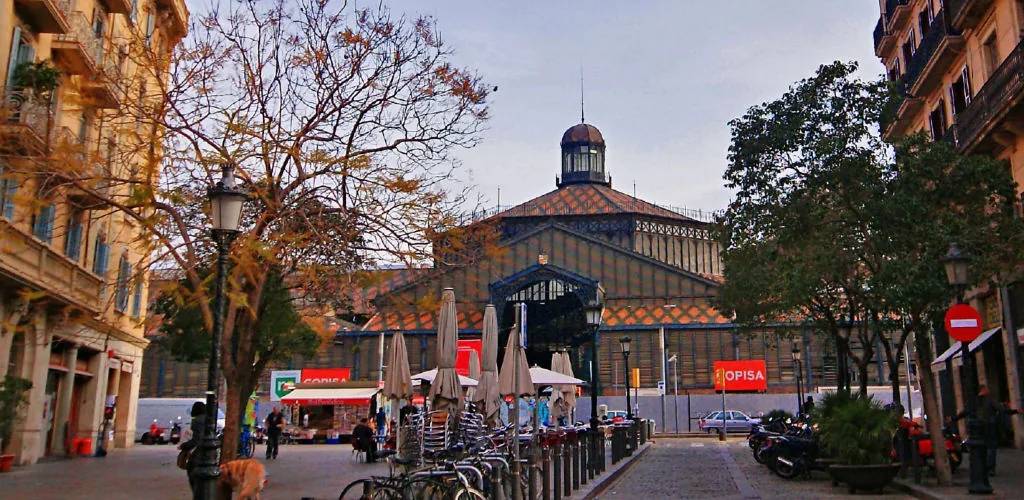
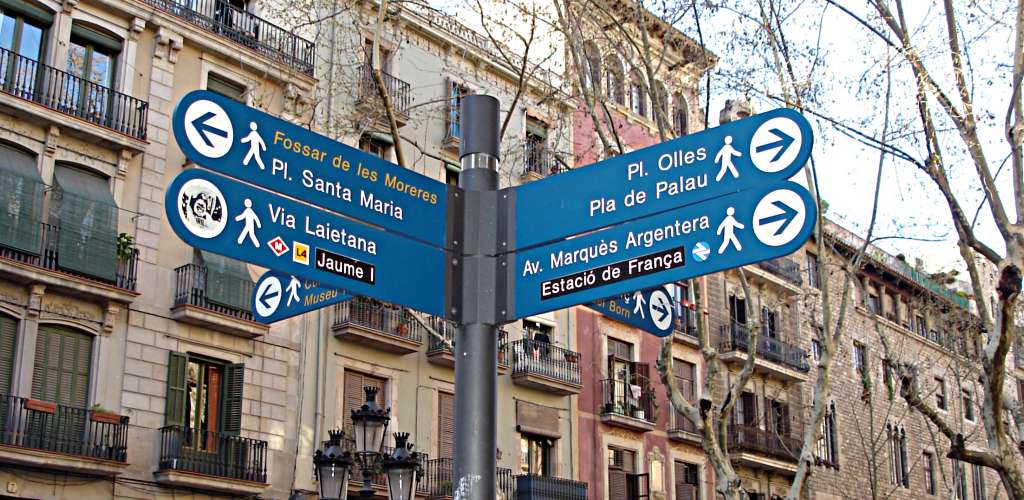
Its limits are the Passeig de Picasso, the Carrer de la Princesa as far as the Carrer del Rec, the Passeig del Born, Santa Maria del Mar, the Pla de Palau and the Avinguda del Marquès de l'Argentera. That list is the boundary of the quarter, not of the church. The basilica stands on the Plaça de Santa Maria, the square in front of its main facade, which was the parish's main burial ground and still holds the public fountain built between 1383 and 1403. Behind it, at the head end, lie the smaller burial ground of the Fossar de les Moreres and the open esplanade of the Born; the streets around it are a web named after the trades that worked there — Abaixadors, Agullers, Argenteria, Carders, Flassaders, Esparteria, Vidreria and others. Among them are Carrer de l'Argenteria, originally Carrer del Mar, the road that led from the old city to the port, and Carrer de Montcada, which met the church at its head end.
La Llotja de Mar is Barcelona's old exchange, on the Passeig d'Isabel II beside the Pla de Palau and about 150 m from the basilica. Its Gothic core — the Contracting Hall and the Consuls' Hall — was raised in the 12th–14th centuries as the seat of the Consolat de Mar, the merchants' quasi-judicial body. In 1714 Philip V took it over as barracks, and from 1772 it was remodelled behind the neoclassical facade it wears today. It is a free-standing quadrangular block delimited by the Pla del Palau, the Plaça d'Antoni López, the Passeig d'Isabel II and the Carrer dels Encants (today the Carrer del Consolat de Mar); those two squares sit at either end of the short Passeig d'Isabel II. In its best days the Llotja stood at the water's edge; its Gothic halls now sit behind an 18th-century facade.
The Rec Comtal was an open channel that began at the Montcada wells, at Montcada i Reixac, and ran nearly 13 km to the sea; the city dates it to the 10th century, in the time of Count Miró I. Inside the walls it worked as a street-canal, partly covered and crossed by bridges — including, in the Born itself, a large one — driving the mills, watering the market gardens and supplying the workshops that needed water. The quarter that became La Ribera grew up on both its banks, and the mouth it cut is remembered in the name Carrer del Rec — the channel that carried its surplus water to the sea — though the Rec's own line ran through Sant Pere, not past the church. The basilica, however, is not on its bank: the nearest point of Carrer del Rec is about 180 m north-east of the church. Santa Maria del Mar was built as a show of the economic power of the inhabitants of the new quarter, and it is the best example of Catalan Gothic: three naves of almost the same height carried on slender octagonal pillars 13 m apart, the whole interior reading as a single open space with almost no ornament — no ogival arches or filigree, only delicate flying buttresses — the opposite of the tall, richly carved Gothic of northern Europe. The city calls it the only entirely finished Catalan Gothic building; the parish calls it the finest example of Catalan Gothic architecture in Catalonia.
The quarter's oldest thread runs back to Sant Pere de les Puel·les, the monastery around which the barri of Sant Pere grew from the 11th century — one of the three quarters, with Santa Caterina and la Ribera, whose joint festival is still the Festa Major del Casc Antic, held every June around Sant Pere's feast day of 29 June.
📚 Get El Born Historical Insights
Join our newsletter for exclusive historical stories, archaeological updates, and heritage insights about El Born district.
We respect your privacy. Unsubscribe at any time. See our Privacy Policy.