


Festa Major del Casc Antic El Born's own June festival
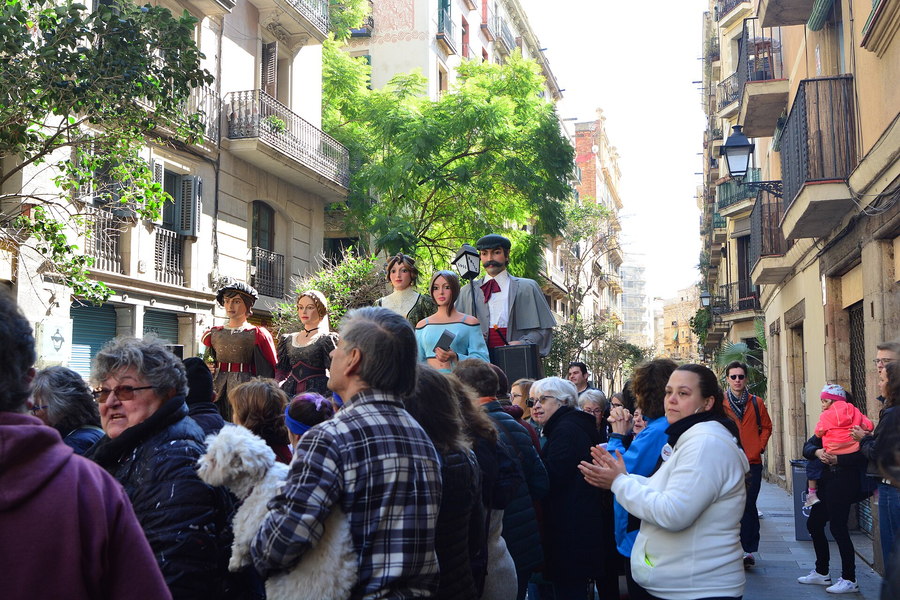
The Casc Antic colla's giants carried through Carrer del Rec in El Born.
Photo: Joe Mabel, CC BY-SA 4.0, via Wikimedia Commons
For one week at the end of June the streets between Sant Pere de les Puel·les and Santa Maria del Mar belong to the neighbourhood instead of the tour groups. This is the Festa Major del Casc Antic dels barris de Sant Pere, Santa Caterina i la Ribera — the neighbourhood festival of the three quarters that make up the area this site calls El Born. It is run by the neighbourhood's own associations, through the Coordinadora Festa Major del Casc Antic, it honours Sant Pere, and it is a street festival: giants carried on shoulders, human towers built in a square, a fire run after dark, long tables in the open air. Nothing is staged behind a barrier, and the street events need no ticket. What follows is what the festival actually is, how its dates work, and which days are worth planning an evening around.
In short
What: the Festa Major del Casc Antic dels barris de Sant Pere, Santa Caterina i la Ribera — the neighbourhood festival of El Born / La Ribera.
When: around the feast of Sant Pere, at the end of June. The feast day itself is 29 June, and the festival's fixed points hang off it.
Where: Ciutat Vella, on the streets around Sant Pere de les Puel·les and Santa Maria del Mar.
Cost: a street festival — you watch from the pavement, and we found no ticketing for the street events.
Plan around: the Saturday closest to 29 June (the trobada de gegants) and 29 June itself (the seguici, the sardanes and the dance in the evening).
What It Is, and Who Runs It
The name is long because the festival is not one neighbourhood's but three: Sant Pere, Santa Caterina and la Ribera, the quarters of the Ciutat Vella district that together make up the Casc Antic. What visitors call El Born is the riverside part of that same block of streets, which is why this is the festival that belongs to the ground these pages walk you around.
It is organised from inside the neighbourhood. The Coordinadora Festa Major del Casc Antic is a coordinating body that brings together the neighbourhood organisations and associations which put the annual festival on in honour of the patron saint, in the last week of June. That structure is the reason the programme looks the way it does: a dozen local groups each contribute their own piece — the giants' colla, the devils' colla, the dance groups, the residents' associations that lay on the communal meals — rather than one promoter booking a week of events.
Two shorthands are worth correcting, because they send people to the wrong place. You will see the festival written up as the “Festa Major de Sant Pere”. Sant Pere is its patron and its feast day is its anchor, but the festival's own name is del Casc Antic, and it is the festival of all three barris, not of a parish. And it is not La Mercè, the city of Barcelona's own festival in September, nor the Festa Major de Gràcia that fills the Gràcia streets in August. Those are different festivals with different programmes and different crowds.
The patron explains the calendar. Sant Pere — St Peter — is portrayed with the keys as guardian of the gates of heaven. The neighbourhood took his name and has him as patron because it grew up around the Sant Pere de les Puel·les monastery from the 11th century. The feast day of Sant Pere, 29 June, is therefore the one date the whole festival is built around.
When It Runs
The rule is simple and it is the one to remember if you are planning a trip: the festival runs around the feast of Sant Pere, at the end of June, and its feast day is 29 June. Every other date in the programme is expressed relative to that day, which is why the festival moves from year to year in the calendar but not in the month.
| What | When | Where |
|---|---|---|
| Sant Pere's feast day | 29 June | The date the programme is built around |
| Seguici i balls dels Gegants de Sant Pere | Late afternoon, 29 June; dance in the evening | Through the neighbourhood streets; the dance in Plaça de l'Església |
| Open-air sardana session | Morning of the saint's day, 29 June | Public square, in the open air |
| Correfoc de festa major | The eve of the saint's day | Neighbourhood streets; sometimes at Sant Pere de les Puel·les and Santa Maria del Mar |
| Trobada de gegants | Afternoon of the Saturday closest to 29 June | Procession through the streets, then a joint dance |
| Diada castellera | The Sunday closest to St Peter's Day | Square in the neighbourhood, with invited colles from Barcelona |
The practical consequence is that the weekend nearest 29 June is the busy one. If you are in Barcelona for a few days at the end of June, the Saturday is the afternoon to keep free — it is the day the neighbourhood's own giants come out to meet the visiting colles — and the 29th is the day to keep free entirely, because the procession, the sardanes and the evening dance all fall on it.
About the dates
We publish the 29 June feast-day rule because that is what the Ajuntament's own Cultura Popular page states, and it does not move. What we do not publish is a hard date for any single edition: in 2026 the city's event listings put the festival in the last week of June, closing on the feast day, but independent listings disagreed over the exact first and last dates. The 2027 edition had not been announced in the sources we checked. Treat 29 June as the anchor and confirm the current edition in the city's listings before you book travel around a specific day.
What Actually Happens
The festival has a folk core and a communal shell. The folk core is the set of traditional set pieces that Catalan neighbourhoods do best, each run by its own local group; the communal shell is the eating, dancing and street life that wraps around them. Both are part of the festival, and the second is the reason locals are on the street rather than watching from behind a rope.
The signature event is the seguici i balls dels Gegants de Sant Pere. Late in the afternoon on the saint's day, 29 June, a seguici de gegants — a procession of giants — makes its way round the neighbourhood's streets. The Sant Pere de les Puel·les parish giants, Pere II el Gran and Constança de Sicília, take part with the smaller gegantona, Isabel. In the evening, when the procession ends, there is a dance in honour of the saint in Plaça de l'Església.
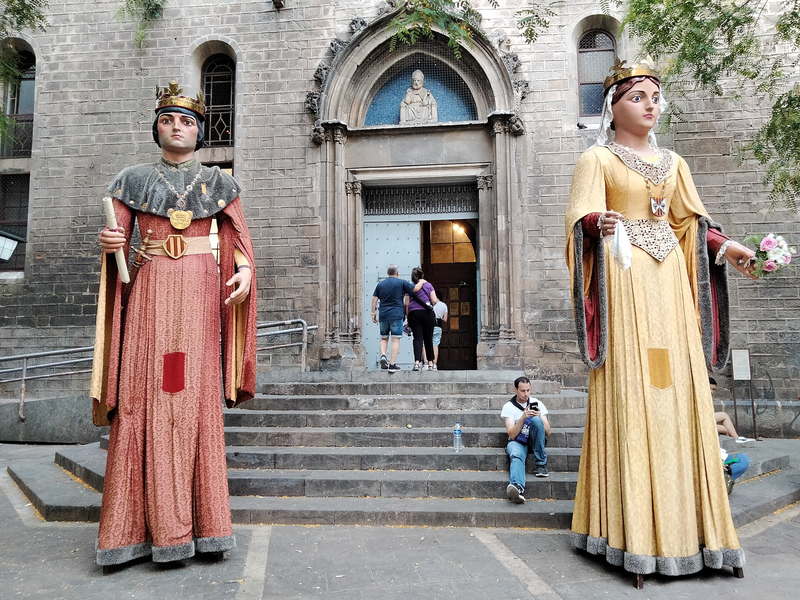
Pere II el Gran and Constança de Sicília, the parish giants of Sant Pere de les Puel·les, on the church steps on the saint's day, 29 June 2023.
Photo: Enric, CC BY-SA 4.0, via Wikimedia Commons
Separately, the neighbourhood's own giants' groups bring out other figures. The Colla de Geganters del Casc Antic brings out the Santa Maria del Mar giants, Peret and Marieta, plus Caterina and Tinet. The two sets of giants are different groups from different houses, and it is worth knowing which procession you are watching: the parish giants of Sant Pere belong to the saint's day seguici, the Santa Maria del Mar giants to their own colla.
The trobada de gegants is the biggest single afternoon. The Colla Gegantera del Casc Antic organises a gathering of neighbourhood giants on the afternoon of the Saturday closest to 29 June; the hosts invite some twenty colles from round the country, and all the groups go round the neighbourhood streets before finishing off with a joint dance. That is roughly twenty sets of giants in one afternoon — the reason this is the day to plan around if you can only pick one.
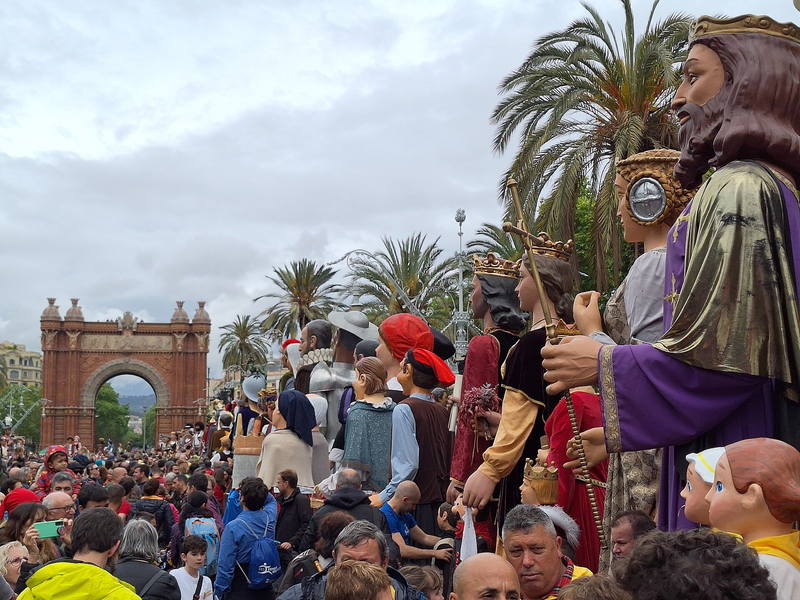
Gegants of many colles lined up for the Trobada Nacional de Gegants in Barcelona, with the Arc de Triomf behind them, 28 April 2024.
Photo: Pere López Brosa, CC BY-SA 4.0, via Wikimedia Commons
The correfoc de festa major is the night one. On the eve of the saint's day the Colla de Diables del Casc Antic runs a fire run through the neighbourhood's streets, sometimes with fire spectaculars and mock church fires at Sant Pere de les Puel·les and Santa Maria del Mar. The same colla also runs a correfoc infantil — a fire run for children — at another point in the festival, which is the version to look for if you are travelling with young kids.
The diada castellera is the human-tower day, on the Sunday closest to St Peter's Day. The organisers invite Barcelona colles to build in the neighbourhood, because the Casc Antic has no human-tower group of its own — so what you see is the city's tower-building scene visiting a barri that hosts it once a year.
Then the dancing. There is an open-air public sardana session on the morning of St Peter's Day, when anyone who knows the steps joins the circle in the square. Balls de bastons — stick dancing — has had its place in the programme for some years, and there is a street display of traditional dancing, Esbarts al carrer, organised by the Esbart l'Espiga d'Or and involving other traditional dance groups.
| Set piece | Who runs it | What to expect |
|---|---|---|
| Seguici i balls dels Gegants de Sant Pere | The Sant Pere de les Puel·les parish giants | Pere II el Gran and Constança de Sicília with the gegantona Isabel; procession, then the dance in Plaça de l'Església |
| Trobada de gegants | Colla Gegantera del Casc Antic | Some twenty colles from round the country; street procession followed by a joint dance |
| Giants of Santa Maria del Mar | Colla de Geganters del Casc Antic | Peret and Marieta, plus Caterina and Tinet |
| Correfoc de festa major | Colla de Diables del Casc Antic | Fire run on the eve of the saint's day; sometimes mock church fires at the two churches; a correfoc infantil separately |
| Diada castellera | The festival with invited Barcelona colles | Human towers, on the Sunday closest to 29 June |
| Dance: sardanes, balls de bastons, Esbarts al carrer | Esbart l'Espiga d'Or among others | Sardana session on the morning of 29 June; stick dancing and a street display of traditional dance |
The words you will hear
Gegants — the giant figures carried and danced through the streets by a colla gegantera, the group that owns and moves them.
Castellers — the human-tower builders; a diada castellera is their display day.
Correfoc — literally a “fire run”: devils and beasts with fireworks moving through the streets after dark. The infantil version is staged for children.
Cercaviles and trobades — a cercavila is a procession round the streets; a trobada is a gathering, when groups come from elsewhere to meet the local ones.
Balls de bastons — stick dancing. A sardana is the Catalan circle dance, open to anyone who knows the steps.
Botifarrada, sopar, vermut — the communal side: a sausage sizzle in the street, a supper, and the pre-lunch vermut that opens a long table.
The communal side is not scenery. The programme is built so that there is a range of activity for all ages: big communal meals including sopars, botifarrada sausage sizzles and vermut; festival dances; street theatre; workshops. This is what makes the week feel like a neighbourhood's own festival rather than a heritage display — the giants are the spectacle, but the tables in the street are the point.
What a Visitor Can Join
Almost all of it. The festival happens on the street, in squares and in front of the two churches, and the set pieces are performed for whoever is standing there — there is nothing to reserve for the procession, the trobada, the castells or the sardanes, and we found no ticketing for the street events. If a workshop or a communal meal needs a name on a list, the programme says so; everything else you simply turn up to.
Two dates to plan around, if you are choosing:
- The Saturday closest to 29 June. The trobada de gegants is the biggest afternoon of the festival — some twenty colles of giants processing and then dancing together. Go for the afternoon, not the evening.
- 29 June itself. Late afternoon brings the seguici of the parish giants, the evening brings the dance in Plaça de l'Església, and the morning brings the open-air sardana session. The eve before it is the correfoc.
Where the activity concentrates is predictable enough. The parish church of Sant Pere de les Puel·les and its square are the festival's home ground, and Santa Maria del Mar is the other church the festival uses — both are on the ground these pages already walk you around. Individual events have also been listed at the Convent de Sant Agustí and on Passeig Lluís Companys, so read the programme rather than assuming everything is in one square.
Getting there is the easy part: the quarter is served by Jaume I (L4, yellow line), and all of the festival ground sits inside the walk covered by our getting to El Born guide. If you are already in the area, the festival combines naturally with the rest of the day: the Mercat del Born and its archaeological site, a walk down the Passeig del Born, and dinner afterwards. For the wider month, see the El Born events calendar, and for the rest of the year's things to do, start with things to do in El Born.
An evening that works
1. Late afternoon on the Saturday closest to 29 June: find the route of the trobada and watch the colles come past, then follow them to the joint dance.
2. On 29 June: the sardana in the morning, the giants' seguici in the late afternoon, the dance in Plaça de l'Església in the evening.
3. The eve of the saint's day: the correfoc. It is loud, the sparks come close, and it is watched from the side of the street rather than from the middle of it — keep back and let the colla work.
4. Eat at the communal events if you can — a botifarrada or a vermut at a long table is the cheapest and most sociable way into the week. Cash helps at street stalls.
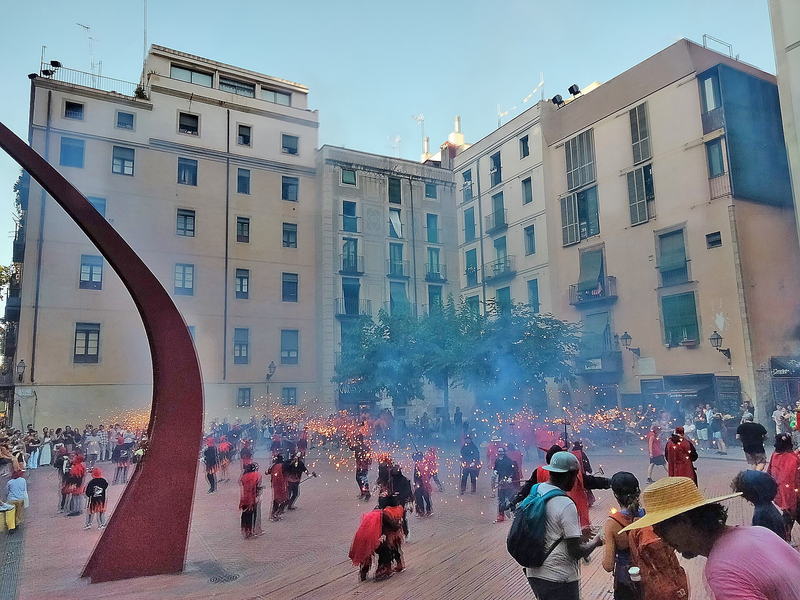
Els Diables del Casc Antic running their fire run in the Fossar de les Moreres during the barri's festa major, 29 June 2025.
Photo: Enric, CC BY-SA 4.0, via Wikimedia Commons
Questions Visitors Ask
When is the Festa Major del Casc Antic?
Around the feast of Sant Pere, at the end of June. The feast day is 29 June, and the festival's fixed points — the giants' seguici, the sardanes, the correfoc on the eve, the trobada on the Saturday closest to 29 June — are all set relative to that date. The 2027 edition had not been announced in the sources we checked.
Is it free?
The street events are. This is a neighbourhood festival held in public streets and squares: you watch the processions, the castells and the correfoc from the pavement, with nothing to book. We found no ticketing for the street programme; if an individual workshop or a communal meal needs sign-up, the published programme will say so.
Is it the same as La Mercè?
No. La Mercè is the city of Barcelona's festival, in September, with the big city-wide programme. The Festa Major del Casc Antic is the neighbourhood festival of Sant Pere, Santa Caterina and la Ribera, in June, run by the neighbourhood's own associations through the Coordinadora Festa Major del Casc Antic. Different month, different scale, different crowd.
What are the gegants, and which ones will I see?
Gegants are the giant figures carried and danced through the streets by a colla gegantera. On the saint's day you see the Sant Pere de les Puel·les parish giants, Pere II el Gran and Constança de Sicília, with the smaller gegantona Isabel. The Colla de Geganters del Casc Antic brings out a different set — the Santa Maria del Mar giants Peret and Marieta, plus Caterina and Tinet.
Where is the programme published?
The Ajuntament's Cultura Popular page for the festival and the city's events listings carry the dates and the programme; both are linked at the foot of this page. The full programme appears ahead of the festival rather than months in advance, so check in the weeks before the end of June rather than planning a trip around a programme you saw early in the year.
Is it worth planning a trip around?
If you are already in Barcelona in late June, yes — it is free, it happens inside the patch these pages already cover, and it is the one week when the streets you are sightseeing in are taken over by the people who live in them. If you would be flying in specifically for it: it is a real neighbourhood festival, not a large-scale production, so treat it as the best evening of a Barcelona trip rather than the reason for one.
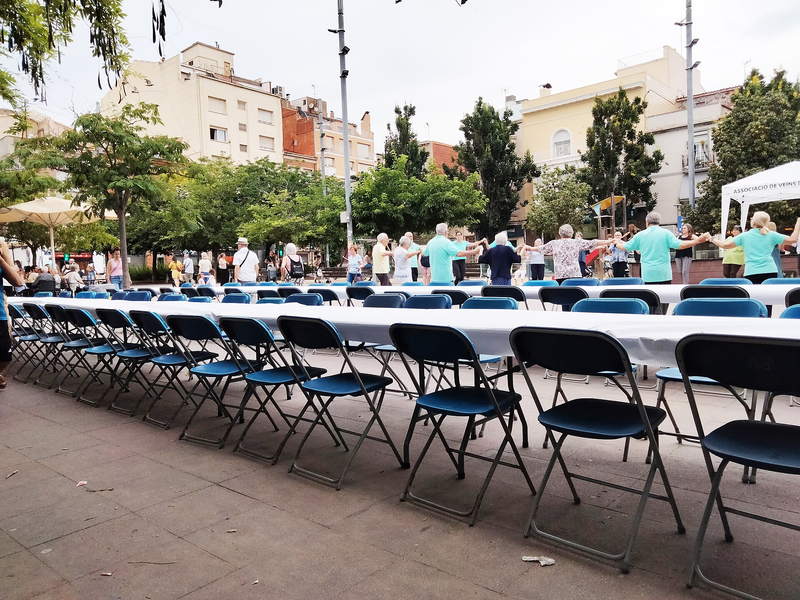
Long tables laid out for the botifarrada at the festa major de Ca n'Aurell in Terrassa, 30 May 2026.
Photo: Enric, CC BY-SA 4.0, via Wikimedia Commons
Key Facts at a Glance
| Full name | Festa Major del Casc Antic dels barris de Sant Pere, Santa Caterina i la Ribera |
|---|---|
| District | Ciutat Vella, Barcelona — the Sant Pere, Santa Caterina and la Ribera quarters |
| Patron and feast day | Sant Pere; feast day 29 June |
| When | Around the feast of Sant Pere, at the end of June; the last week of June in 2026, closing on the feast day. Sources differ on exact start and end dates; the 2027 edition was not announced when we checked. |
| Organised by | Coordinadora Festa Major del Casc Antic, coordinating the neighbourhood's organisations and associations |
| Cost | The street events are free to watch; we found no ticketing for them |
| Signature events | Seguici i balls dels Gegants de Sant Pere (29 June); Trobada de gegants (Saturday closest to 29 June); Correfoc de festa major (eve of the saint's day); Diada castellera (Sunday closest to 29 June); sardanes and Esbarts al carrer |
| Communal side | Sopars, botifarrada sausage sizzles, vermut, festival dances, street theatre, workshops |
| Official pages | Ajuntament de Barcelona — Cultura Popular: Festa major del Casc Antic and the city's Festes majors listing |
The festival facts on this page come from the Ajuntament de Barcelona's Cultura Popular page for the festival and the city's festes majors listing, both consulted on 26 October 2026. The festival's own programme is the only authority on a given year's timings — use the official pages above for that, and the events calendar for what else is on in the city at the same time.