
How to get to El Born

El Born has one real gateway: Jaume I on metro line 4, five minutes on foot from Passeig del Born. Almost every route below ends there. What changes is how you get into the city from El Prat — and the cheapest way in costs about a tenth of what the taxi does.
| Option | Cost | What it involves | Best for |
|---|---|---|---|
| Aerobús, then metro | €7.75 one-way or €13.30 return, plus a €2.90 metro ticket | About 35 minutes to Plaça Catalunya; every 5–10 minutes, 24 hours | Most visitors: frequent, runs all night |
| R2 Nord train, then metro | €2.90, or one journey on a T-Casual | To Barcelona Sants, then a change at Passeig de Gràcia | Landing at Terminal 2 with light luggage |
| TMB bus 46, then metro | €2.90, or one journey on a T-Casual | About 40 minutes to Plaça Espanya; both terminals | The lowest fare, if you are not in a hurry |
| Taxi | About €30–45 metered; €21.00 minimum from the airport | Rank outside both terminals; no booking needed | Luggage, groups, late arrivals |
| Private transfer | Fixed price agreed before you travel | Driver meets you in arrivals | Groups and families arriving together |
From El Prat airport
Aerobús, then metro
The Aerobús is the airport coach and the option most people take. It costs €7.75 one-way or €13.30 return, with the return valid for 90 days, and it leaves from both terminals every 5–10 minutes, 24 hours a day. The run to Plaça Catalunya takes about 35 minutes.
From Plaça Catalunya, take metro L1 one stop to Urquinaona, then L4 one stop to Jaume I. Line 4 does not serve Plaça Catalunya, so a single L4 hop from there is not possible — the change at Urquinaona is the way. Total for the journey: €10.65.
Buying tickets without queueing twice
Buy the Aerobús ticket at the machine or from the attendant at the stop, and the metro ticket at Plaça Catalunya when you change. If you plan to move around the city for several days, work out whether a T-Casual or a Hola Barcelona card is cheaper before you buy the metro single — the ticket table below sets out what each covers.
The R2 Nord train, then metro
Renfe's R2 Nord is the cheapest way in from Terminal 2. The airport stop sits inside zone 1, so there is no airport supplement: a €2.90 single, or one journey on a T-Casual, covers the train and the metro that follows. That is roughly €1.30 a journey if you are using a T-Casual.
The train runs into the city through Barcelona Sants; change at Passeig de Gràcia for L4 and Jaume I. One catch worth knowing before you choose it: the R2 Nord station serves Terminal 2 only, so if you land at T1 you take the free inter-terminal shuttle across first.
TMB bus 46, then metro
The city bus is the slow, cheap option and it is easy to miss on the airport forecourt because it looks like any other TMB bus. Line 46 runs from both terminals (T1 and T2B/T2C) to Plaça Espanya for a normal bus fare — €2.90, or one T-Casual journey — and stops often enough that you should allow about 40 minutes from T2. There is no luggage rack; it is a city bus with city-bus space.
At Plaça Espanya take L1 to Urquinaona and change to L4 for Jaume I. Two changes in total, and the lowest fare of any option here.
Taxi and ride-hailing
Taxis wait at ranks outside both terminals. You cannot hail one from the kerb at arrivals — join the queue at the rank. The meter is regulated, and the tariff in force for 2026 is a flag fall of €2.80, then €1.35 per km on weekdays between 08:00 and 20:00 or €1.66 per km at night, on Saturdays and on holidays, plus the €4.60 airport supplement each way. The regulated minimum fare from the airport is €21.00 including every supplement; for the roughly 13 km to El Born, expect about €30–45.
Ride-hailing works differently: Uber and Cabify do not pick up at the kerb, and the app sends you to the terminal's VTC pickup area instead, which is a short walk from arrivals. The fare is quoted in the app before you confirm, so you can compare it with the queue at the rank.
Private transfer
A pre-booked transfer is the one option where the price is settled before you fly. The driver meets you in arrivals, the vehicle is sized to your party, and there is no queue and no change of train. It costs more than the meter for one or two people and less than it looks for four or more with luggage, which is the case where it makes sense.
🚗 Book Airport Transfers
Pre-book your airport transfer for guaranteed service and competitive prices:
✓ Meet & Greet service ✓ Free cancellation ✓ No hidden fees
Jaume I: the station you actually arrive at
Jaume I is on line 4 and is the closest station to the quarter — a five-minute walk from the station exits to the middle of Passeig del Born. It is step-free: it is not on TMB's list of stations waiting to be adapted, and the two step-free ways in are the lifts at Plaça de l'Àngel and at Argenteria. The plain Carrer de l'Argenteria entrance is stairs, not a ramp.
| Coming from | The route | Time |
|---|---|---|
| Passeig de Gràcia | L4 direct, towards La Pau | 2 stops, 4–5 minutes |
| Barcelona Sants (AVE and long distance) | L3 to Passeig de Gràcia, then L4 | About 15 minutes, one change |
| Sagrada Família | L2 to Passeig de Gràcia, then L4 | The L4 leg is the same two stops |
| Park Güell | L3 from Lesseps to Passeig de Gràcia, then L4 | The L4 leg is the same two stops |
| Plaça Catalunya | L1 one stop to Urquinaona, then L4 | 2 stops in total |
Two of those routes have a trap in them. Sagrada Família is on L2 and L5 but not L4, and Park Güell has no metro station of its own, so both need the change at Passeig de Gràcia; from there the run into Jaume I really is two stops. Anything that tells you to take L4 from Plaça Catalunya is wrong — that station is L1 and L3 only.
Barceloneta and Urquinaona: when to use them instead
Barceloneta is one stop past Jaume I on L4, on the sea side of the quarter. It is the station to use if you are coming from the beach or staying down by the port and the marina: it puts you at the southern edge, about five minutes on foot to the south end of Passeig del Born. If your hotel is closer to the waterfront than to the church, it is the better door.
Urquinaona (L1 and L4) sits on the northern edge, by the Palau de la Música Catalana and the top of Via Laietana. It is the useful station if you are arriving from the Eixample on L1, or going to a concert. It is also one of the handful of metro stations in the city that is not yet step-free, so with a wheelchair, a pushchair or heavy cases, stay on to Jaume I.
Coming from inside the city
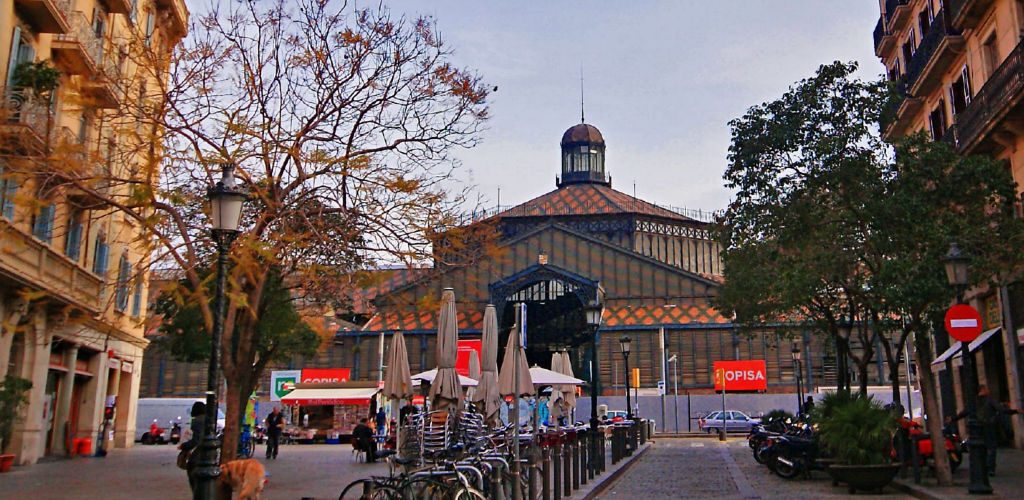
From Les Rambles and the Gothic Quarter, walk. Carrer de la Princesa runs from the Rambla into the heart of El Born and is the direct line; the alternative is to wander through the Gothic Quarter's lanes, which takes longer and is the reason to do it. You will not need the metro if you are already at the bottom of the Rambla.
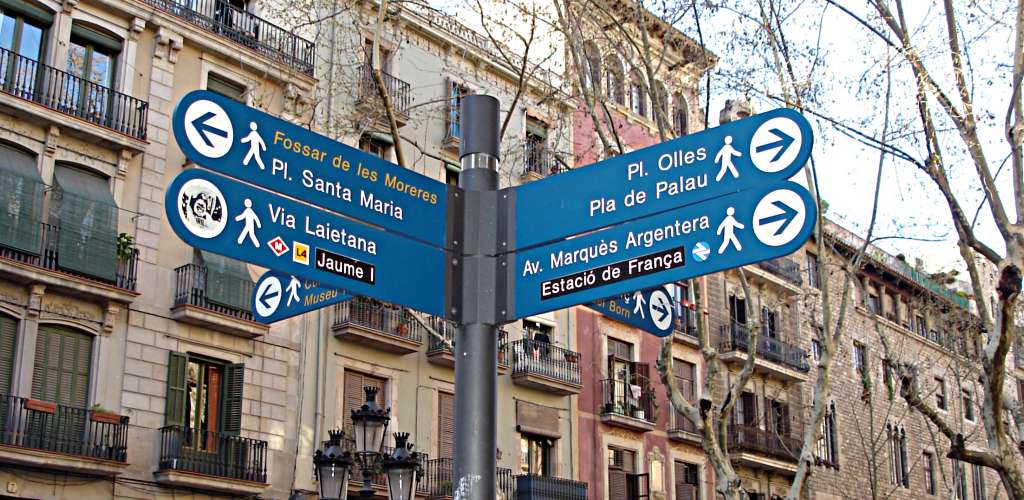
From Estació de França, walk as well. The station sits on the district's eastern edge at Avinguda del Marquès de l'Argentera, close enough that a metro ride is a detour — it is a walk, and the station building itself is worth the two minutes it takes to look at. Regional trains stop here.
From Plaça Catalunya, L1 one stop to Urquinaona and L4 one stop to Jaume I. From Passeig de Gràcia, L4 direct — two stops, four or five minutes.
Tickets: what to buy
| Ticket | Price | What it covers |
|---|---|---|
| Single ticket, zone 1 | €2.90 | One metro or city bus journey |
| T-Casual, 10 journeys, zone 1 | €13.00 | Metro, city buses including line 46, and the R2 Nord airport train. Not valid at the L9 Sud airport metro stations |
| Airport metro ticket, L9 Sud | €5.90 | Only for the metro stations at the airport itself |
| Hola Barcelona, 24 h / 48 h / 72 h | €12.50 / €18.70 / €27.30 | Unlimited travel including the airport metro. Not valid on the Aerobús |
| Hola Barcelona, 96 h / 120 h | €35.60 / €43.60 | The same card over four or five days |
El Born is zone 1, so a single ticket is all you need to reach it from anywhere in the centre. The €5.90 airport metro ticket only applies if you take the metro from the airport; the Aerobús is a separate fare and the T-Casual does not cover it.
Buses and night buses
Line 120 is the neighbourhood shuttle: a Ciutat Vella loop that stops at Via Laietana–Pl. Ramon Berenguer, Francesc Cambó–Freixures, Gombau–Jaume Giralt and Placeta del Comerç, all inside the quarter or on its edge. It is useful for short hops that the metro does not cover, not for getting across the city.
When the metro stops for the night, the Nitbus takes over. Lines N0, N6 and N8 stop at Pla de Palau and along Via Laietana, on the quarter's edge; N12, N24 and N28 use the same stops. N0 is the circular route that links the nightlife districts and passes Barceloneta metro.
If you are arriving after midnight, you have two clean options: the Aerobús runs 24 hours, or a taxi from the rank. The Nitbus is for getting home once you are already in the city, not for the airport run.
Taxis, driving and parking
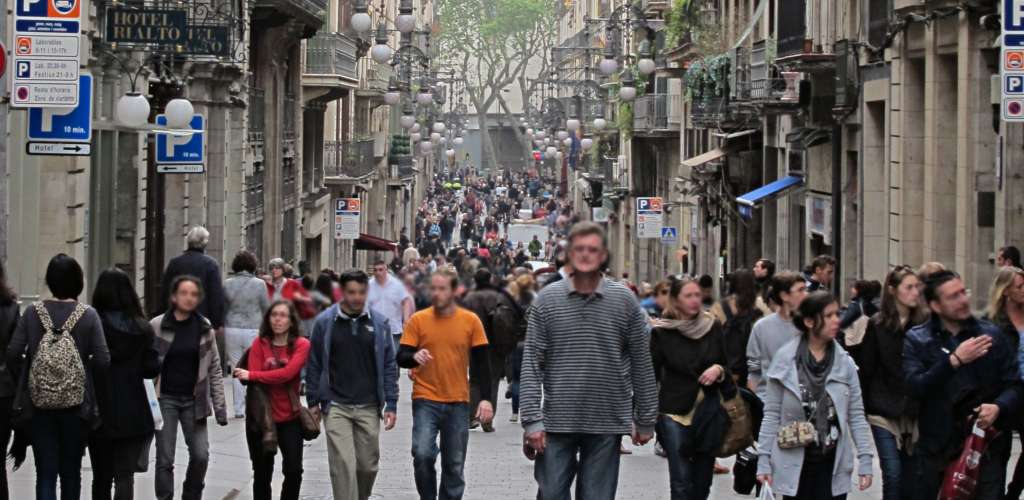
Inside the quarter, Via Laietana is where the traffic runs. Passeig del Born and most of the lanes around it are pedestrian, so you will not flag a cab down in the middle of El Born; walk to Via Laietana, or book a car by app or phone. For an adapted vehicle, see the accessibility section below.
Driving here is possible and rarely worth it. The streets are narrow, and the parking that exists is underground on the edge of the quarter. Two car parks put you within a few minutes of the Passeig:
| Car park | Where | Rate |
|---|---|---|
| Saba Bamsa Francesc Cambó | Avinguda de Francesc Cambó 10, under the Santa Caterina market, entered from Via Laietana | €4.20 per hour; 643 spaces on three levels; open 24 hours; 2.0 m height limit |
| BSM Moll de la Fusta | Passeig de Colom 1, by the port | €3.20 per hour; €41.55 for 13–24 hours; €19.15 overnight; open 24 hours; 1.95 m height limit |
Do not plan on street parking inside the quarter — most of it is pedestrian, and the rest is not somewhere to leave a car while you walk away from it.
Accessibility
Jaume I is step-free, via the lifts at Plaça de l'Àngel and Argenteria. Do not assume that is true of the whole line: nine of the metro network's 165 stations are not adapted, and two of them are on L4 — Verdaguer and Urquinaona. So a route that changes at Urquinaona is not a step-free route, and it is worth checking any interchange before you commit to it.
The bus network is fully accessible — every city bus has been low-floor with a ramp since 2007 — which makes line 120 and bus 46 genuinely usable with a wheelchair or a pushchair.
For an adapted taxi, call Radio Taxi 033 on +34 933 033 033, the largest operator of adapted taxis in the city, with about 50 adapted vehicles. They must be booked ahead; you cannot flag one down at a rank.
Apps worth having
- TMB — the operator's own app: real-time arrivals and mobile tickets.
- Citymapper — the best of the three for multi-leg journeys where you have to change between metro and bus.
- Google Maps — reliable for walking directions in the old city, where the lanes do not follow a grid.
Common questions
Which metro station is closest to El Born?
Jaume I on L4, five minutes on foot from Passeig del Born. Barceloneta, one stop further, is the better door for the beach and port side; Urquinaona is the northern edge, by the Palau de la Música, but it is not step-free.
How much is the Aerobús from Barcelona airport?
€7.75 one-way or €13.30 return, with the return valid for 90 days. It leaves both terminals every 5–10 minutes, around the clock, and takes about 35 minutes to Plaça Catalunya.
Is there a train from the airport into Barcelona?
Yes — the R2 Nord from Terminal 2, with no airport supplement, so a €2.90 single or one T-Casual journey covers it. From T1 you take the free shuttle to T2 first, and you change at Passeig de Gràcia for L4.
Do I need a special ticket to get to El Born?
No. El Born is in zone 1: a €2.90 single or a T-Casual at €13.00 for ten journeys covers the metro and the city buses. The exceptions are the Aerobús, which has its own fare, and the metro stations at the airport, which need the €5.90 airport ticket.
How these figures were checked
Fares were checked on 7 November 2026 against the published 2026 prices from Aerobús, TMB and Renfe, and against the AMB/IMET taxi tariff in force from 19 January 2026. Transport prices in Barcelona change with the January fare revision, so if you are reading this in a later year, treat the numbers as the date they carry and confirm before you travel.
More on El Born
Once you arrive, the Passeig del Born is the place to start. The complete guide to El Born covers the Picasso Museum, Santa Maria del Mar and the rest of the quarter's sights; eating in El Born and our tapas bar guide cover where to eat, and staying in El Born covers where to sleep once you have decided to stay.