


La Mercè Festival Barcelona: Dates, What Happens and Where to See It
La Mercè is Barcelona's festa major — the city's own annual festival, held in honour of the Mare de Déu de la Mercè and built around her feast day on 24 September. For the length of the festival the Ajuntament fills the squares, streets and parks of all ten districts with a programme of some 500 activities: the Pregó de la Mercè and the Toc d'Inici that open it, the sardana, the gegants, castells and the correfoc, and the Piromusical de la Mercè that closes it. Almost all of it is free. The 2026 edition ran from Wednesday 23 to Sunday 27 September 2026, and this guide explains how the dates work each year, what the set pieces actually are, how the metro runs during the festival, and which parts happen in Ciutat Vella, the district El Born belongs to.
When is La Mercè? How the dates work
The fixed point is the feast day itself. 24 September, the Mare de Déu de la Mercè, is a local public holiday in Barcelona — marked L in the city's official holiday calendar rather than as a state or regional holiday — and that is already settled for both 2026 (a Thursday) and 2027 (a Friday). If you are planning around the festival at all, that is the one date you can hold on to years ahead.
Why that day? The city's own account of the festival's history ties it to the legend of the Virgin appearing on the night of 24 September 1218; centuries later, during the locust plague of 1687, Barcelona placed itself under her protection, and the pope ratified her status as the city's patron saint in 1868. The festival became a civic event in 1871, and the model it set is the one still followed by festes majors across Catalonia.
Everything else is decided edition by edition. The Ajuntament publishes the run of the current festival only, so there is no permanent rule such as "the last week of September" to rely on. In 2026 the festival ran from Wednesday 23 to Sunday 27 September: it opened on the evening before the feast day with the reading of the Pregó de la Mercè and the Toc d'Inici in the Plaça de Sant Jaume at 7 p.m. (19:00), and closed on the Sunday night with the Piromusical de la Mercè at 10 p.m. (22:00) on Nova Icària beach.
| What | Date | Status |
|---|---|---|
| Mare de Déu de la Mercè — local public holiday (marked L) | 24 September | Confirmed for 2026 (Thursday) and 2027 (Friday) |
| La Mercè 2026 | Wednesday 23 – Sunday 27 September 2026 | Held — five days, opened by the Pregó de la Mercè on the evening of 23 September |
| La Mercè 2027 | Not announced | Only the 24 September holiday is confirmed; the city publishes the run closer to the time |
Planning for 2027
The city has not announced the dates of the 2027 festival. The only confirmed 2027 fact is that 24 September — a Friday — is the local holiday. Expect a span of days around that date and check the Ajuntament's own La Mercè site once the programme is published; any guide that prints 2027 dates today is guessing.
What happens: the set pieces
Most of La Mercè is popular culture rather than ticketed spectacle. The festival's own history describes its most traditional activities as a compendium of Catalan culture — the Gironese sardana, the human castles and the devils of Camp de Tarragona — and adds that Barcelona's speciality is its street parades, descendants of the processions once staged for Corpus Christi. In practice that means a recognisable set of pieces you can plan a day around.
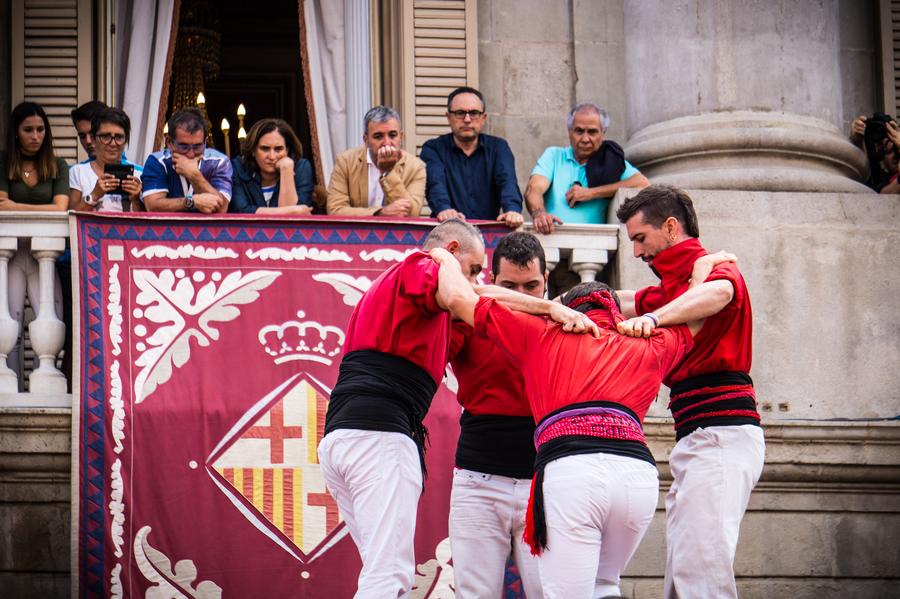
Castellers building a human tower in front of the Ajuntament de Barcelona on the Plaça de Sant Jaume, La Mercè 2017.
Photo: Dbascones, CC BY-SA 4.0, via Wikimedia Commons
The festival opens with the Pregó de la Mercè, the opening speech, followed by the Toc d'Inici. Both happen in the Plaça de Sant Jaume on the opening day from 7 p.m., and they are the moment the city declares the festa major started. The same day also carries the Festa Major bell ringing, which happens away from the square: in 2026 the churches of the Gothic Quarter rang out from Pla de la Seu at 5 p.m. for ten minutes, and the bells of the Basílica de la Mercè, in the Plaça de la Mercè, ring again at noon on the feast day itself. The inaugural sardana dancing fills the Avinguda de la Catedral in the early evening, and the opening procession sets out from the Palau de la Virreina. Late that night comes the Xambanga de gegants, the giants' parade, back in the Plaça de Sant Jaume.
The gegants are the oversized painted figures that the city's popular-culture groups parade through the streets; the castells are the human towers built by castellers; and the correfoc is the fire run, when devils and fire beasts shower the streets with sparks. The correfoc is the one piece to approach with respect rather than curiosity: the Ajuntament publishes its own safety advice in the festival FAQs, and it sets up a Lilac Point on Passeig de Gràcia at the correfoc (see the safety note below).
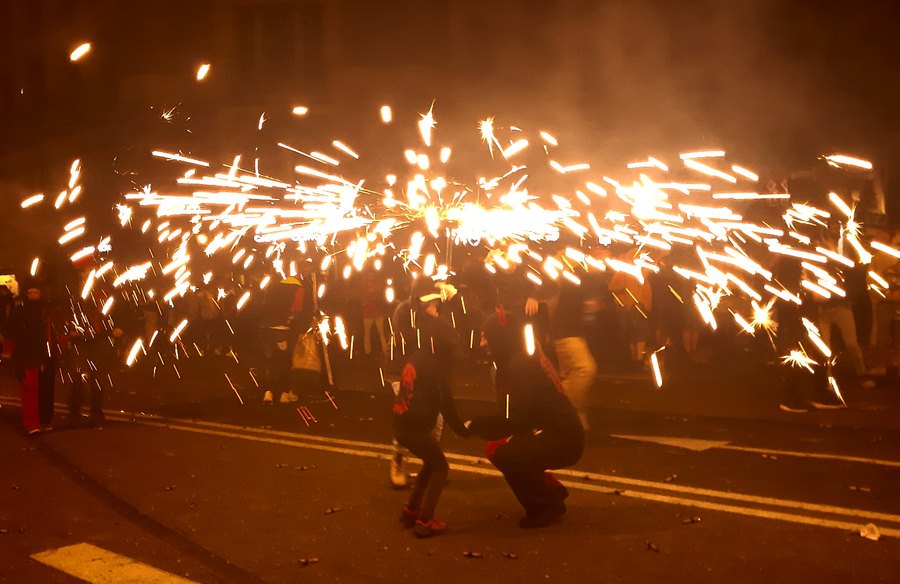
The correfoc on Via Laietana during La Mercè 2019, with the city's devils and fire beasts out in the street.
Photo: MagdaLena7, CC BY-SA 4.0, via Wikimedia Commons
The festival closes with the Piromusical de la Mercè: a fireworks display designed to run in time with a soundtrack, held on the final night at 10 p.m. In 2026 it was staged on Nova Icària beach rather than its traditional site on Avinguda de la Reina Maria Cristina, with the fireworks designed by Pirotècnia Igual and the soundtrack curated by Josep Montero of Oques Grasses. That is exactly why you check the operator's own Piromusical page before setting off: the site has moved before.
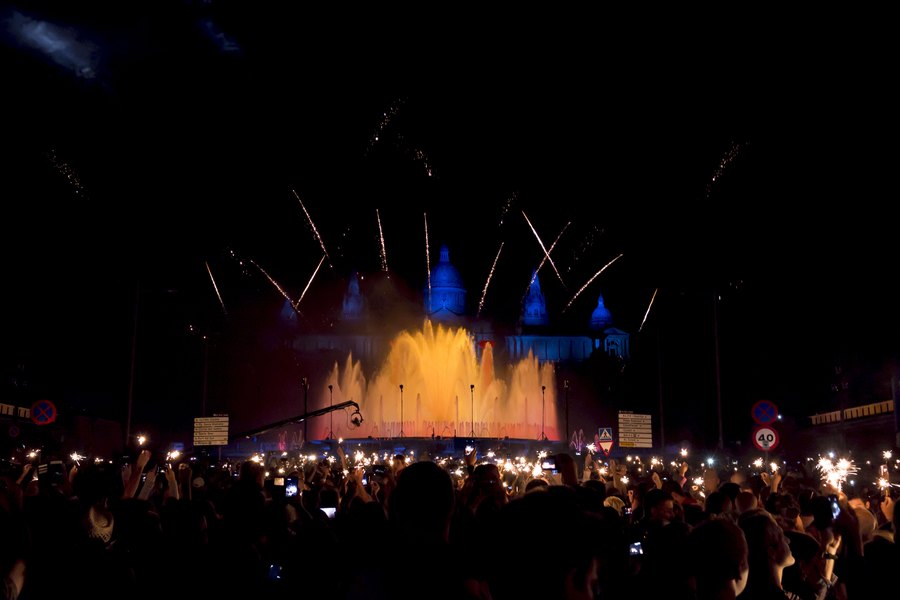
The Piromusical at its traditional site below Montjuïc, Avinguda de la Reina Maria Cristina, in 2015. In 2026 the display moved to Nova Icària beach.
Photo: Dbascones, CC BY-SA 4.0, via Wikimedia Commons
| Set piece | What you will see | Where | Cost |
|---|---|---|---|
| Pregó de la Mercè and Toc d'Inici | The opening speech and the formal start of the festival | Plaça de Sant Jaume, opening day from 19:00 | Free |
| Festa Major bell ringing | The bells that mark the start of the festa major | Pla de la Seu (Gothic Quarter), opening day 17:00–17:10 | Free |
| Inaugural sardana dancing | The sardana, danced in a circle by anyone who joins | Avinguda de la Catedral, opening evening | Free |
| Opening procession | The festival's opening parade through the old city | Sets out from the Palau de la Virreina, opening evening | Free |
| Xambanga de gegants | The giants' parade — the city's gegants out in the square | Plaça de Sant Jaume, opening night | Free |
| Castells | Human towers built and dismantled by castellers | Across the city during the run | Free |
| Correfoc | The fire run — devils and fire beasts, sparks and drums | City streets; a Lilac Point is set up on Passeig de Gràcia | Free |
| Piromusical de la Mercè | Fireworks choreographed to a curated soundtrack | Nova Icària beach, final night at 22:00 | Free |
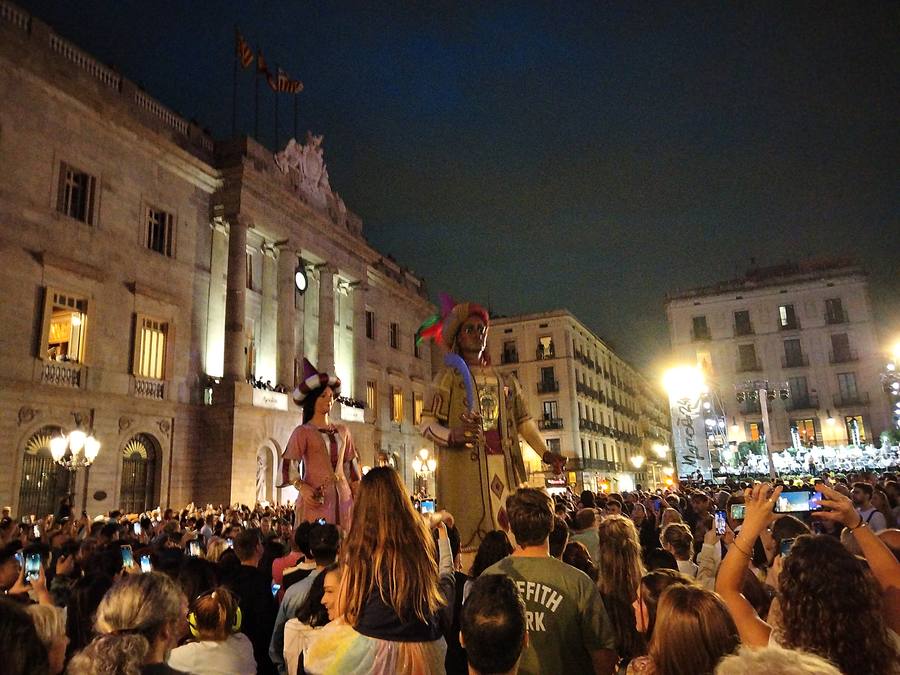
The Gegants del Pi in the Seguici inaugural de la Mercè on the Plaça de Sant Jaume, 20 September 2024 — the festival's opening procession.
Photo: Enric, CC BY-SA 4.0, via Wikimedia Commons
The rest of the programme: MAC, BAM, Música Mercè and Acció Cultura Viva
The traditional pieces are the spine of La Mercè, not the whole of it. The programme runs to some 500 activities, and the city organises them under a handful of named strands. MAC – Mercè Arts de Carrer is the street-arts strand — arts de carrer is Catalan for street arts — with shows in squares, streets and parks. BAM (Barcelona Acció Musical) is the music festival within the festival, Música Mercè the programmed concerts, and Acció Cultura Viva runs alongside them.
Each edition also has a guest city, which brings its own companies and programme to Barcelona; in 2026 it was Shanghai. And the geography matters as much as the line-up: the activities are spread across all ten districts — Ciutat Vella, Eixample, Gràcia, Horta-Guinardó, Nou Barris, Sant Andreu, Sants-Montjuïc, Sant Martí, Les Corts and Sarrià-Sant Gervasi — which is why the festival feels less like one event than like the whole city deciding to stay outside for a few days.
La Mercè in and near El Born and Ciutat Vella
Because the programme covers every district, Ciutat Vella gets its own share — and the pieces that land in the old city are the traditional ones. The Pregó de la Mercè, the Toc d'Inici and the Xambanga de gegants all take place in the Plaça de Sant Jaume; the Festa Major bell ringing is a few streets away, the churches of the Gothic Quarter ringing out from Pla de la Seu; the inaugural sardana is danced on the Avinguda de la Catedral; and the opening procession starts from the Palau de la Virreina on La Rambla. El Born is itself part of Ciutat Vella, so all of these are within the same district as the neighbourhood — you can walk out of El Born and be in the middle of the opening day without planning a journey.
The Palau de la Virreina does double duty during the festival. It is the address of Porta Cultura (La Rambla, 99), the city's information point for La Mercè, open every day from 10 a.m. to 8 p.m. on 933 161 000 — useful if you are staying in El Born and want a paper programme, or want to ask a person rather than an app what is on that evening.
For the rest of the day, El Born itself is worth keeping in the plan rather than treating as a corridor to the squares: the Passeig del Born and the streets around Santa Maria del Mar hold the neighbourhood's own bars and restaurants, which is where you will want to end a festival evening. Our guide to things to do in El Born covers the non-festival side of the neighbourhood, and the September 2026 events page lists what else is on that month. If you are still settling on dates, our guide to when to visit El Born sets the festival month against the rest of the year's weather and crowds.

El Born's pedestrian streets are part of Ciutat Vella, the district that hosts La Mercè's traditional ceremonies in the Plaça de Sant Jaume, the Avinguda de la Catedral and the Palau de la Virreina.
Getting around during La Mercè
The city adjusts the metro for the festival, and the adjustments are worth knowing before you decide where to stay or how late to go out. The network runs continuously through the nights of Wednesday 23, Friday 25 and Saturday 26. On Thursday 24, the public holiday, the service runs until midnight rather than all night. On the night of the Piromusical, Sunday 27, every line is reinforced — especially L4, the yellow line, which is the one that matters on both ends of your evening.
L4 is the useful line for this festival if you are based in El Born: Jaume I is the station for the neighbourhood, and the same line runs out towards the beach end of the city. The Ajuntament's own directions for reaching Nova Icària beach for the Piromusical point to L4 Ciutadella | Vila Olímpica. Full details of the neighbourhood's metro, bus and walking options are in our guide to getting to El Born.
| Night | Metro service |
|---|---|
| Wednesday 23 September | Continuous service all night |
| Thursday 24 September (public holiday) | Service until midnight |
| Friday 25 September | Continuous service all night |
| Saturday 26 September | Continuous service all night |
| Sunday 27 September (Piromusical) | All lines reinforced, especially L4 |
Service information during the festival is published by the city and by TMB at tmb.cat. On the night of the Piromusical, when the whole seafront is in use, the metro is the safer assumption.
What's free, and what to book
Entry to La Mercè activities is free, and that extends further than the street programme: the city's municipal museums and cultural facilities offer free admission during the festival. The caveats are administrative rather than financial. Some venues ask you to book in advance even when entry is free, so check the conditions on each centre's own site before you turn up with a group.
Where to get the programme
- Online and in the app: the La Mercè website and the official La Mercè app carry the programme by day, time, space, type of activity and district.
- Porta Cultura — Palau de la Virreina, La Rambla, 99. Open every day, 10 a.m. to 8 p.m. Telephone 933 161 000.
- 010, the city information line, from 7 a.m. to 11 p.m. every day.
- Printed programme: distributed free with Barcelona's main newspapers from 17 September in 2026, and available from 16 September at Sala Ciutat and at Porta Cultura.
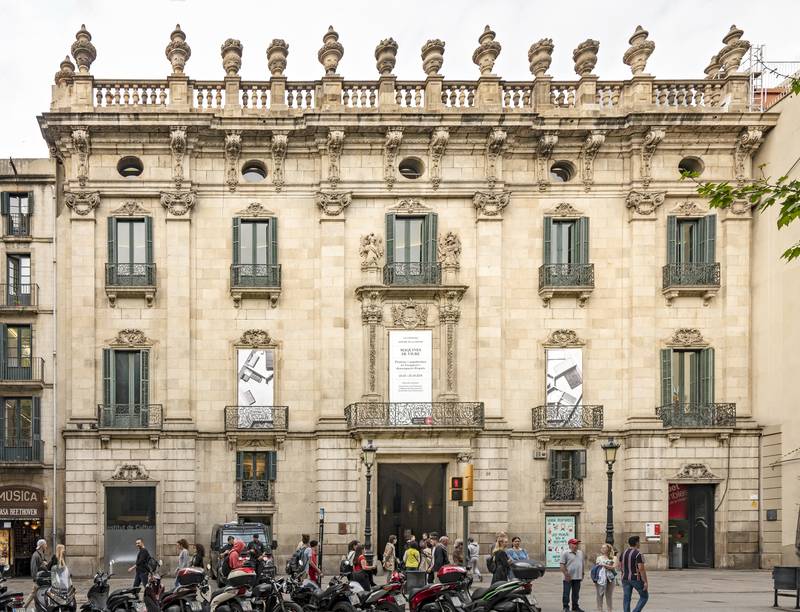
The Palau de la Virreina on La Rambla, where Porta Cultura runs the festival's information point at number 99.
Photo: Didier Descouens, CC BY-SA 4.0, via Wikimedia Commons
Safety, and where to get help
For a Mercè free of sexist violence the city sets up Lilac Points — support points for women — at Bogatell beach, on Reina Maria Cristina Avenue and on Passeig de Gràcia at the correfoc. For any emergency, call 112. The fire runs are the one part of the festival where it pays to read the organiser's guidance first: the festival FAQs set out how close to stand, what to wear and what not to bring.
La Mercè: frequently asked questions
When is La Mercè in Barcelona?
It is built around 24 September, the feast day of the Mare de Déu de la Mercè and a local public holiday in the city. The 2026 edition ran from Wednesday 23 to Sunday 27 September 2026, opening with the Pregó de la Mercè on the evening of 23 September and closing with the Piromusical on the night of the 27th.
Are the 2027 dates announced?
No. The only confirmed 2027 detail is that 24 September 2027 — a Friday — is the local public holiday. The city publishes the festival's run for the current edition only, so expect a span of days around 24 September and confirm it on barcelona.cat/lamerce as the edition approaches.
Is La Mercè free?
Yes. Entry to the festival's activities is free, and Barcelona's municipal museums and cultural facilities offer free admission during La Mercè. Some venues may still require you to book ahead even when entry is free, so check each venue's conditions.
What happens on 24 September itself?
24 September is the feast day and the city's local public holiday. The formal opening — the Pregó de la Mercè and the Toc d'Inici in the Plaça de Sant Jaume — happens on the evening before, so the feast day itself falls in the middle of the run, with shows and activities in the squares, streets and parks through the day.
Does the metro run all night during La Mercè?
On three nights, yes: Wednesday 23, Friday 25 and Saturday 26 September 2026 ran continuous service. Thursday 24, the public holiday, ran until midnight, and on the night of the Piromusical, Sunday 27, all lines were reinforced, especially L4.
Where do I get the programme?
From the La Mercè website and the official app, from Porta Cultura at the Palau de la Virreina (La Rambla, 99, open daily 10 a.m. to 8 p.m.), by calling 010 between 7 a.m. and 11 p.m., or in printed form — in 2026 it came free with the main newspapers from 17 September and was available from 16 September at Sala Ciutat and Porta Cultura.
Key facts at a glance
| What it is | Barcelona's festa major, in honour of the Mare de Déu de la Mercè |
|---|---|
| Feast day | 24 September — local public holiday (marked L), confirmed for 2026 and 2027 |
| Most recent edition | Wednesday 23 – Sunday 27 September 2026 |
| Opening | Pregó de la Mercè and Toc d'Inici, Plaça de Sant Jaume, opening day from 19:00 |
| Closing | Piromusical de la Mercè, Nova Icària beach, final night at 22:00 |
| Scale | Some 500 activities across all ten city districts, including Ciutat Vella |
| Cost | Free, including free admission to municipal museums; some venues require advance booking |
| Transport | Metro continuous on three festival nights; L4 reinforced on the Piromusical night |
| Information | Porta Cultura, La Rambla 99, daily 10:00–20:00, 933 161 000; city line 010, 07:00–23:00 |
| 2027 | Festival dates not announced; 24 September 2027 (Friday) is the local holiday |
Sources: the Ajuntament de Barcelona's La Mercè site — barcelona.cat/lamerce/en (programme and FAQs), traditional festivities, history and the Piromusical page; and the city's official holiday calendar at ajuntament.barcelona.cat/calendarifestius/en. Details quoted are for the 2026 edition unless stated otherwise.
Looking further ahead? The 2026 Barcelona events calendar covers the rest of the year month by month.